
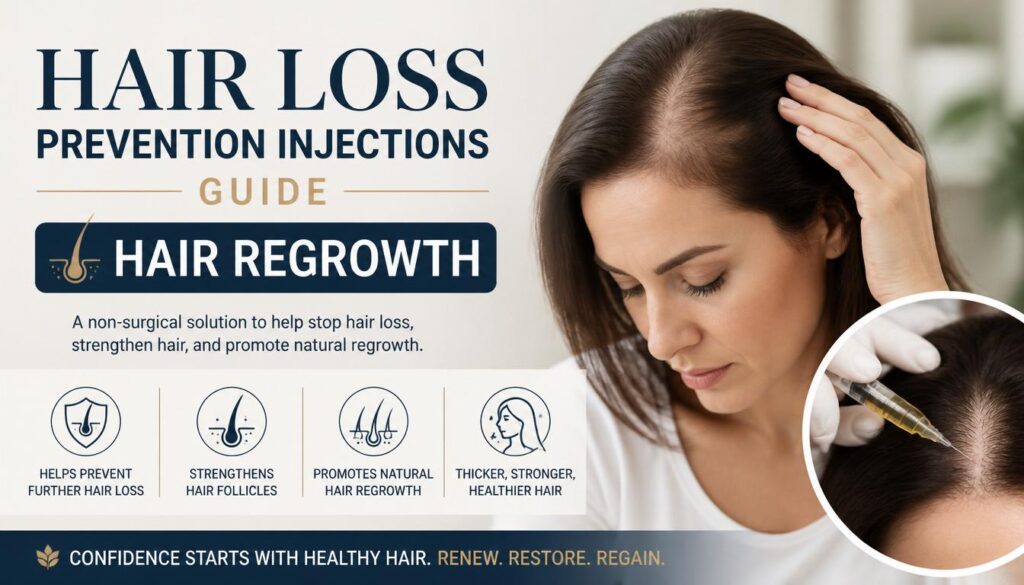
Discover how hair loss prevention injections work, including PRP, exosomes, peptides, and other therapies. Learn benefits, risks, results, FAQs, and expert tips.
What Are Hair Loss Prevention Injections?
Hair loss prevention injections are minimally invasive medical treatments designed to support scalp health and promote healthier hair growth. Depending on the treatment, they may deliver platelet-rich plasma (PRP), growth factors, peptides, or other regenerative substances into the scalp. These injections aim to create a healthier environment for hair follicles and may help reduce hair shedding while improving hair density in appropriate candidates. Results vary by individual, and treatments should be performed by qualified healthcare professionals following an accurate diagnosis of the underlying cause of hair loss.
Introduction
Hair loss affects millions of men and women across the United States. While losing 50–100 hairs per day is considered a normal part of the hair growth cycle, persistent thinning, widening part lines, receding hairlines, or patchy hair loss may indicate an underlying issue that deserves medical evaluation.
Hair loss can result from many factors, including genetics, hormonal changes, nutritional deficiencies, autoimmune conditions, medications, stress, illness, and aging. Because the causes vary widely, there is no single treatment that works for everyone.
In recent years, hair loss prevention injections have become increasingly popular in dermatology and hair restoration clinics. These minimally invasive treatments aim to support scalp health, stimulate the hair follicle environment, and complement evidence-based therapies for certain types of hair loss.
This guide explains the science behind hair loss prevention injections, compares available options, discusses benefits and limitations, and outlines realistic expectations to help readers make informed decisions.
Understanding Hair Loss
Healthy hair grows through a repeating cycle:
Anagen (Growth Phase)
The active growth stage, lasting several years.
Catagen (Transition Phase)
A short phase where the follicle begins to shrink.
Telogen (Resting Phase)
Hair rests before shedding.
Exogen (Shedding Phase)
Older hairs naturally fall out, allowing new hairs to grow.
Disruptions to this cycle can contribute to hair thinning or excessive shedding.
Common Causes of Hair Loss
- Androgenetic alopecia (male and female pattern hair loss)
- Telogen effluvium (stress-related shedding)
- Nutritional deficiencies (iron, vitamin D, zinc, protein)
- Thyroid disorders
- Hormonal changes
- Autoimmune conditions such as alopecia areata
- Certain medications
- Tight hairstyles (traction alopecia)
- Aging
- Chronic illness
A dermatologist can determine the underlying cause before recommending treatment.
What Are Hair Loss Prevention Injections?
Hair loss prevention injections are scalp-based treatments intended to improve the environment around hair follicles. Rather than replacing hair surgically, these therapies aim to support follicle function and complement the body’s natural hair growth process.
Common injection-based approaches include:
- Platelet-Rich Plasma (PRP)
- Platelet-Rich Fibrin (PRF)
- Peptide-based therapies
- Exosome therapies (investigational in many settings)
- Other regenerative approaches under clinical evaluation
Treatment recommendations should always be individualized.
Types of Hair Loss Prevention Injections
Platelet-Rich Plasma (PRP)
PRP is prepared from the patient’s own blood. After processing, a concentrated layer of platelets rich in growth factors is injected into targeted scalp areas.
Research suggests PRP may improve hair density and reduce shedding in some individuals with androgenetic alopecia, although responses vary.
Platelet-Rich Fibrin (PRF)
PRF is a newer autologous treatment that contains platelets and fibrin in a slower-releasing matrix.
Some clinicians use PRF as an alternative to PRP, but protocols continue to evolve.
Peptide-Based Treatments
Certain injectable peptides are being studied for their potential role in tissue repair and scalp health.
Evidence is still developing, and treatment availability varies.
Exosome Therapies
Exosomes are extracellular vesicles involved in cell signaling.
While they have generated significant interest in regenerative medicine, the FDA has not approved exosome products for hair restoration, and their safety and effectiveness continue to be investigated.
How Hair Loss Prevention Injections Work
These therapies generally aim to:
- Support scalp circulation
- Deliver growth factors or signaling molecules
- Encourage a healthier follicular environment
- Promote normal tissue repair processes
- Complement existing follicles rather than create new ones
Results depend on the health of existing follicles and the underlying cause of hair loss.
Benefits
Potential benefits may include:
Reduced Hair Shedding
Some patients experience less daily hair shedding after a treatment series.
Improved Hair Density
Hair may appear fuller if more follicles remain in the active growth phase.
Better Hair Thickness
Existing hairs may appear thicker over time.
Non-Surgical Approach
No incisions or hair transplantation are involved.
Minimal Downtime
Most patients return to routine activities within a day, following provider instructions.
Who May Be a Good Candidate?
Injection-based therapies may be considered for adults with:
- Early-stage androgenetic alopecia
- Mild to moderate thinning
- Diffuse shedding after evaluation
- Healthy existing hair follicles
They are generally less effective when follicles are permanently destroyed or absent.
The Treatment Process
Consultation
Your provider reviews:
- Medical history
- Hair loss pattern
- Scalp examination
- Current medications
- Laboratory results (if needed)
Treatment
The scalp is cleaned, and injections are placed into targeted areas.
Duration
Appointments typically last 30–60 minutes, depending on the procedure.
Recovery & Aftercare
Patients are often advised to:
- Avoid harsh scalp treatments for a short period
- Follow individualized washing instructions
- Protect the scalp from excessive sun exposure
- Attend scheduled follow-up sessions
Always follow your provider’s specific guidance.
Results Timeline
First Month
Little visible change may occur.
Two to Three Months
Some individuals notice reduced shedding.
Three to Six Months
Hair density and thickness may gradually improve if the treatment is effective.
Maintenance schedules vary depending on the therapy used.
Risks & Safety
Possible temporary side effects include:
- Mild swelling
- Redness
- Tenderness
- Bruising
- Temporary scalp sensitivity
Rare complications include infection or allergic reactions (depending on the product used).
Treatments should only be performed in a medical setting by qualified professionals.
Hair Loss Prevention Beyond Injections
The best outcomes often involve a comprehensive approach:
Nutrition
Consume adequate protein, iron, zinc, omega-3 fatty acids, and vitamins.
Scalp Care
Use gentle shampoos and avoid excessive heat styling.
Stress Management
Chronic stress can contribute to increased shedding.
Medical Therapies
Depending on the diagnosis, a dermatologist may recommend FDA-approved options such as topical or oral medications.
Lifestyle
- Get adequate sleep
- Exercise regularly
- Avoid smoking
- Maintain a healthy weight
Myths vs Facts
Myth: One injection permanently cures hair loss.
Fact: Hair loss usually requires ongoing management, and results vary.
Myth: Every type of hair loss responds the same way.
Fact: Treatment depends on the underlying diagnosis.
Myth: More injections always produce better results.
Fact: Treatment protocols should be individualized.
Myth: Hair supplements alone replace medical treatment.
Fact: Supplements may help when deficiencies exist but are not substitutes for medical evaluation.
Frequently Asked Questions
Are hair loss prevention injections FDA-approved?
Some procedures, such as PRP, use a patient’s own blood and are performed under physician supervision, while many regenerative products remain investigational for hair restoration. Discuss the regulatory status of any treatment with your provider.
Do injections hurt?
Most patients experience mild discomfort. Numbing techniques may be used when appropriate.
How many sessions are needed?
Treatment plans vary based on diagnosis and response. Many protocols involve an initial series followed by maintenance sessions.
Can women receive hair loss injections?
Yes, depending on the cause of hair loss and medical evaluation.
Can injections replace a hair transplant?
No. They are different treatment approaches and may be complementary in some cases.
When should I see a dermatologist?
If hair loss is sudden, patchy, painful, associated with scalp inflammation, or rapidly worsening, seek medical evaluation promptly.
Conclusion
Hair loss prevention injections represent an exciting area of modern hair restoration, offering minimally invasive options that may help support healthier hair growth in carefully selected patients. Treatments such as PRP and other regenerative approaches aim to improve the scalp environment and preserve existing hair follicles rather than provide an instant or permanent cure.
The most successful outcomes begin with an accurate diagnosis, evidence-based treatment, realistic expectations, and long-term maintenance. Combining medical therapies with balanced nutrition, stress management, gentle scalp care, and healthy lifestyle habits provides the strongest foundation for maintaining healthy hair.
Ready to Take the Next Step?
If you’re experiencing persistent hair thinning or increased shedding, schedule a consultation with a board-certified dermatologist or qualified hair restoration specialist. A personalized treatment plan—including scalp evaluation, lifestyle recommendations, and appropriate medical or regenerative therapies—can help you make informed decisions and support healthier hair for the long term.